One of the most important seasonal
celebrations prior to the advent of Christianity was the summer solstice. After the
acceptance of Christianity in the Basque Country (around the eleventh century), many pagan
rituals were transformed into Catholic feast days. The
celebration of the Summer Solstice became the day of Saint John the Baptist. Important
symbols of this day are fire, water, and certain plants. People walked barefoot in the dew
on the morning of Saint Johns day in order to prevent diseases throughout the coming
year. Water collected from fountains on that day was believed to possess special curative
properties. Likewise, plants gathered at this time are used to cure and prevent certain
maladies. Branches cut on this day are also hung near the front door of a dwelling to
protect it and its inhabitants.
Bon fires are built and jumped over as a symbol of purification. The
plants and branches remaining from the year before are added to the fire and replaced with new ones. The fire was also said to protect the
fields from witches, predators and pests. It was believed that one who kept ashes from the
fire would be protected against storms. These bonfires were also accompanied by songs and
incantations which referred to the magic of this day. The women of Urdiain, Nafarroa
celebrated Saint Johns day by encircling the bonfire and performing an incantation
known as San Juanen Kantaita.
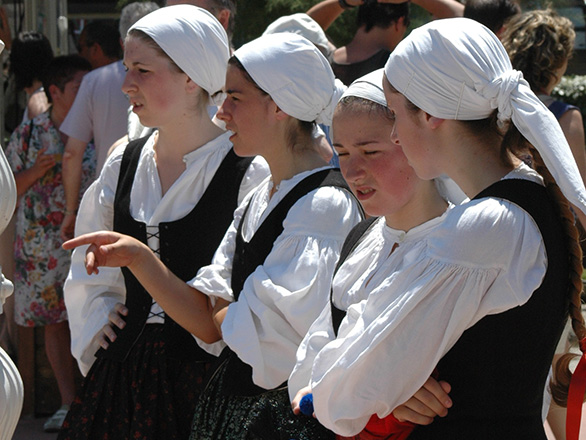
In inclement weather, the women of this region used their second skirt
as a sort of raincoat or cape by lifting the back of it and placing it over their heads.
The square shape you notice in the front is the result of wearing an orratzontzia, or
needle holder, wrapped in a scarf around the forehead. This was a practical way for them
to carry their needles, leaving their hands free, as they went to participate in communal
sewing sessions at another home.
San Juanen Kantaita:
Egun bai egun honek San Juan dirudi
ez da san Juan baina hala alunbra bedi
Goazen San Juanera gaur arratsean
etorriko gerala bihar goizean
Goazen San Juanera beduratara
berduratara eta han egotera
Joan nintzen Fraintziara etorri maiatzean
zalditxo urdinean astuaren gainean
San Juango iturriaren ondotik
zazpi iturri urre kainuetatik
zortzigarrrena metal zurietatik
San Juango iturriaren ura dago berde
amuarraitxo freskoak hantxe dirade
lemizko eskua ta gero musua
San Juango iturriaren freskua
Jesukristoren lehengusua da
Aita San Juan Bautista
aingeruak dantzan dabiltza
dabiltza baia dabiltza
San Juanen pozean dabiltza
Andra mutur maketsa
aingeruak dantzan dabiltza
dabiltza baia dabiltza
San Juanen pozean dabiltza
San Juan garagarrilean denbora galantean
maizik eta garirik ez dagonean etxean
Orain arte behar, hemendik aurrera gari!
Written Sources:
Arrarás, Francisco. Danzas e indumentaria de Navarra: merindad de Pamplona I.
Pamplona 1987: 58-63.
Azkue, Resurreción María. Cancionero popular vasco
II. Barcelona.. 1924:63.
Caro Baroja, Julio. La estación de amor. Madrid.
1979.
Feliu Corcuera, Alfredo. Baga, biga, higa.
Bilbao: Ediciones Mensajero. 1991: 122-127.
San Juan en Urdiain in Enciclopedia de Navarra.
221-228.
Direct Source consulted by Zenbat Gara:
Ane Albisu of Argia. Tape recording by Ane Albisu, Agurtzane Arregi and Maite Ramos. |